This post is purely a result of my own curiosity. I was reading a book and it mentioned the SOLO Taxonomy, which got me to wondering exactly how many taxonomies were out there! I found a total of… 5? So, I just wanted to get to know a bit about each of them. Feel free to read on or wait until next week for a new post!
SOLO Taxonomy (Structure of the Observed Learning Outcome)
What is it?
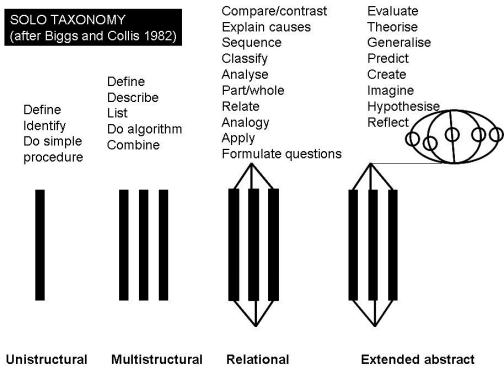
The SOLO Taxonomy is a learning taxonomy that classifies learner outcomes in terms of complexity.
The four levels of complexity are:
unistructural – the learner has acquired one or a few aspects of the task
multistructural – the learner has required several unrelated aspects of the task
relational – the learner is able to generalize the whole task to untaught applications
extended abstract – untaught application of the task
Purpose
SOLO Taxonomy is intended to work with constructive alignment, the instructional process of starting with intended learning outcomes and aligns teaching and assessment to those outcomes. This taxonomy is often used to set high expectations and increase student motivation when they realize that there is a real point to what is being taught and assessed.
Pros
- complements Bloom’s Taxonomy
- offers guidance on how to move from stage to stage
Cons
- may seem too complex and unwieldy for most teachers to attempt
- “The Sinister 16”: verbs that are passive, internal and otherwise unobservable
Implementation Tips
- To move from “prestructural” to “unistructural” – address misconceptions.
- To move from “unistructural” to “multistructural” – over-learn facts to automaticity.
- To move from “multistructural” to “relational” – practice investigating connections.
- To move from “relational” to “extended abstract” – practice with synthesis and evaluation.
Bloom’s Taxonomy
What is it?
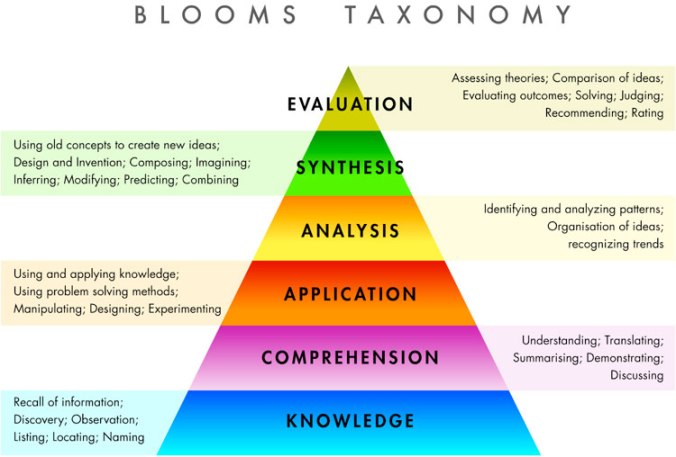
Bloom’s Taxonomy was developed in 1956 to promote higher forms of thinking in education. It lists three domains (or taxonomies) of learning: cognitive, affective, and psychomotor. It classifies six major categories of cognitive processes:
- knowledge
- comprehension
- application
- analysis
- synthesis
- evaluation
Purpose
to promote higher forms of thinking in education
Pros
- has been more thoroughly developed and revised over time
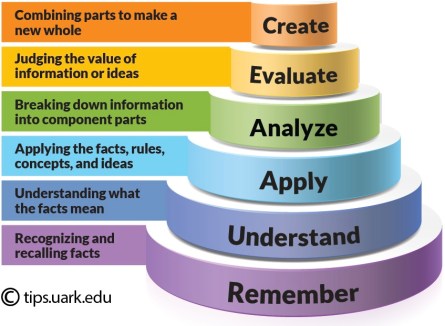
- Bloom’s Revised Taxonomy reflects a more active form of thinking by replacing the names of the six categories (nouns to verbs)
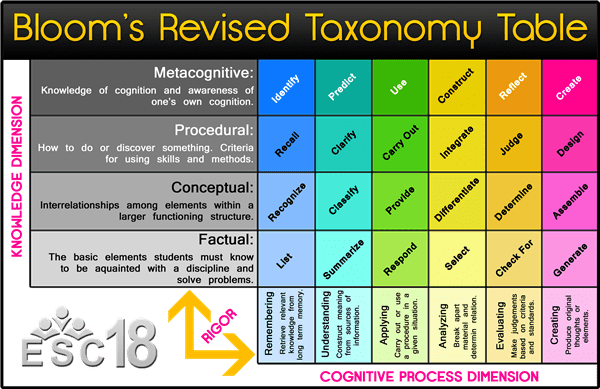
- Bloom’s Revised Taxonomy incorporates a cognitive and knowledge matrix
- targets learning objectives by seeking to increase knowledge, develop skills, or develop emotional aptitude and/or balance
- provides a basis for developing sub-goals and assessment methodology to meet these goals
Cons
- simplistic at first draft
- becoming increasingly complex and unwieldy
Implementation Tips
(see charts below)
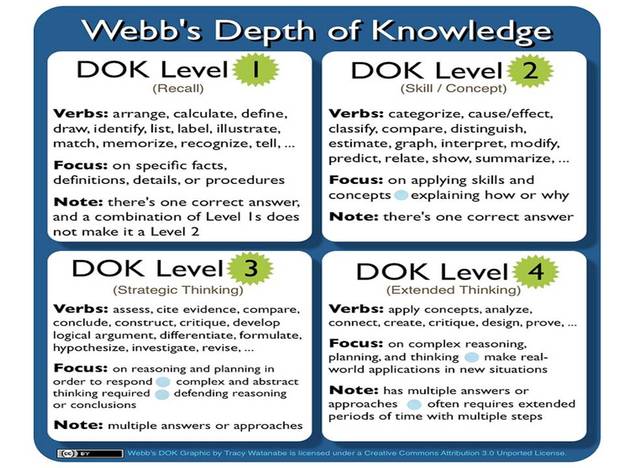
Webb’s Depth of Knowledge
What is it?
a learning taxonomy that reflects the complexity of the cognitive processes demanded by a task
Levels
Level One: Recall and Reproduction
Level Two: Skills and Concepts
Level Three: Strategic Thinking
Level Four: Extended Thinking
Purpose
to analyze the cognitive expectation demanded by standards, curricular activities, and assessment tasks
Pros
- complements Bloom’s taxonomy (Bloom’s determines the cognition or thinking and Webb’s designates the context – the scenario, setting and situation)
Cons
- that darn DOK wheel simplifies this taxonomy too much
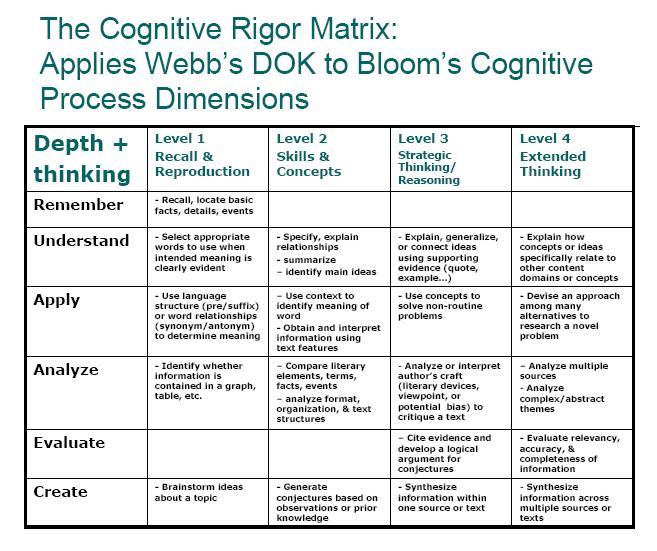
- alignment between Bloom’s and Webb’s might be better described by the Cognitive Rigor Matrix/Hess Matrix
Implementation Tips
(see chart below)
Cognitive Rigor Matrix/Hess Matrix
(best explained in chart – see below)
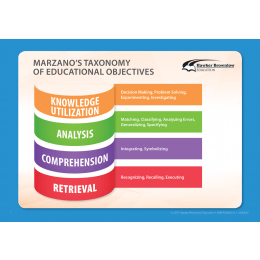
Marzano’s New Taxonomy
What is it?
a new taxonomy of educational objectives
made up of three systems and the Knowledge Domain
- Self-System: decides whether to continue current behavior or engage in new activity
- Metacognitive System: sets goals and keeps track of progress
- Cognitive System: processes all necessary information
- Knowledge Domain provides content
Purpose
developed in response to shortcomings of Bloom’s Taxonomy
Pros
not enough known
Cons
not enough known
Implementation Tips
see learning goals and scales
A Visual Comparison
See you next week!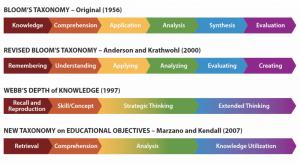

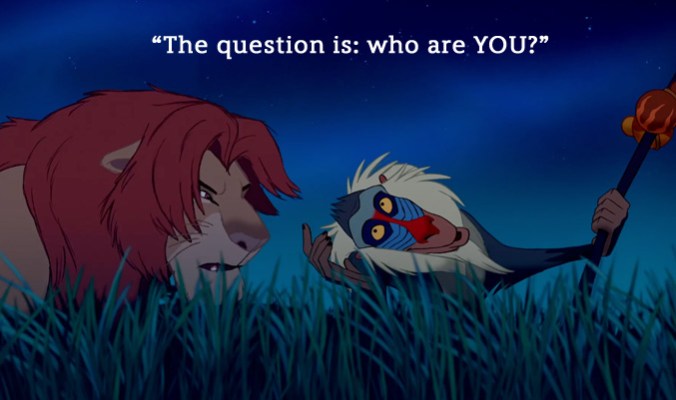 OK. Obviously, I could not resist. Disney films have a way of being so profound and yet so simple. Primple? Or simfound? I guess I won’t try to coin any new terms today. But have you ever really, thoroughly considered this question: Who are you?
 EdShots