(School) Climate Change

climate-change

I am a life-long learner. I am and have been proud to say that I matriculated  from every institution  I attended. (Except for current school of enrollment, of course). I have been a proud Brigham Bear, J.A.M. middle schooler, Bloodhound, and Gator.

I think that the most disappointing part of becoming an instructional coach is knowing the potential a school has to develop a positive and thriving climate, but not seeing that potential becoming a reality. Thus, I have decided to actively include in my coaching role small tricks to help schools develop inclusive and supportive school climates.

School climate is defined by the National School Climate Center (2014) as “the quality and character of school life… based on patterns of students’, parents’, and personnel’s experience of school life and reflects norms, goals, values, interpersonal relationships, teaching and learning practices, and organizational structures.”

In nurturing climates:

  • teachers are more likely to take risks
  • teachers and students find enormous growth opportunities
  • youth develop into citizens who can be productive members of a democratic society
  • students, teachers, and families all work together to create a shared school vision
  • educators model the joy and pleasure of learning for their students
  • students feel safe at school
  • teachers use literature that depicts marginalized populations in a positive manner
  •  teachers have student debates in their classrooms that focus on social justice issues

I wondered what I could do, as only a coach, to nurture the development of inclusive and supportive school climates. These are some tasks on my list:

  1. build collective teacher efficacy in content area groups
  2. build trust and maintain it!
  3. offer opportunities for teachers to connect and learn from one another
  4. hold high expectations, but create opportunities for success
  5. Glow, Grow, and Go
  6. use social media to help teachers brand themselves and their schools
  7. start with strengths


DeWitt, Peter. (2017). Collaborative Leadership: Six influences that matter most. Thousand Oaks, CA: Corwin.

Flip Your Coaching!

As a teacher, it always irritated me to sit through long, boring informational meetings. I felt I was enough of a professional to be given the information and allowed to read through it on my own and ask questions about anything I didn’t understand. I am sure I can not be the only teacher who felt that way.

I feel the same way now. What I will never understand is why, once we know what “turned us off” as teachers, we continue to use those same arcane and ineffective practices as coaches.

In his book, Collaborative Leadership: Six influences that matter most, Peter DeWitt, explains how he used flipped faculty meetings to keep the focus on learning. I believe that it is highly important that we never forget that learning should always be our primary focus – information is vital to have and it should be presented in such a way as to maximize learning.

Flipped coaching is perfect for adult learners because it allows teachers to be self-directed. In DeWitt’s model of the flipped meeting, he used TouchCast (an app) to upload a 5-minute video explaining information he thought the staff should know before the meeting. He was also able to add pictures and links to supplement the information provided in the video. This flipped meeting model made DeWitt’s faculty meetings more productive and encouraged dialogue.

I have decided to make use of flipping in my coaching strategy for this year. A colleague and I started with the app, Flipgrid. I chose this app rather than TouchCast because (1) I do not use/have/like Apple devices, and (2) it is user-friendly, especially for those who are not technologically inclined.

We are currently using Flipgrid in our small group professional learning community, but I do hope to expand to a model that I use with teachers. I’ll let you know how it goes!

topLogo


Better Coaching Conversations

One part of coaching that I am struggling with is to refrain from insisting on “my way” as THE way to be an effective teacher. Although I know my methods are not the only methods or even the best methods, I lack that ability to be able to use conversation to allow teachers to self-reflect and come up with their own solutions to issues.

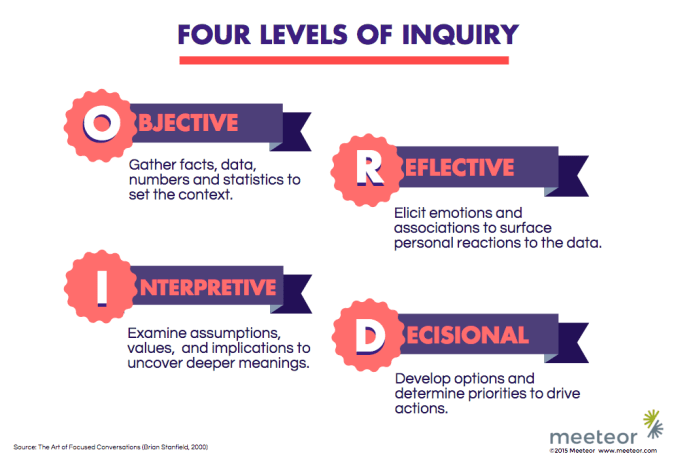
One framework that I plan to use to help me counteract that tendency is the O.R.I.D. Framework. This framework categorizes questions as objective, reflective, interpretive, or decisional. This logical sequence of questions “invite[s] reflection and insight and point[s] to next steps” (Johnson, Leibowitz, & Perret, 2017).

ORID-chart

  • Objective questions are easy to answer and aimed at identifying pertinent facts and information (to relieve stress and invite active participation). These are typically “what” questions, such as What were the key points you noted about…? What did you observe during the…? What body language did you notice in the participants?
  • Reflective questions elicit emotional response and personal reactions, inviting a deeper level of participation. These questions ask, “What about ‘the what’?” Examples include What was the most/least successful thing you noted? What seemed to really work/not work? What concerns you/confuses you/annoys you? What was exciting, surprising, or frustrating about…? How did you feel as you were…?
  • Interpretive questions invite sharing and generate options and possibilities for the future, asking “So what?” Examples include What did you learn about yourself through this experience? What are things that you might have done/could do that would have enhanced/would enhance the outcome? What do these results mean to you in terms of future planning? What other ways could you assess…? What insights have you gained about how you…?
  • Decisional questions develop opinions options, or solutions that lead to future actions, clarifying expectations for improvement or change. Essentially, these are “Now what?” questions, such as What things will you do differently? What things will you do the same? Which of your skills will you further develop, and what will you do to develop them? What are your next steps? What supports will you need to continue to work on those areas?

Hopefully, this helps you as well in whatever line of work you are in because, honestly, we are all coaches! Wish me luck!

Johnson, Jessica, Leibowitz, Shira, and Perret, Kathy. (2017). The Coach Approach to            School Leadership: Leading teachers to higher levels of effectiveness. ASCD: Alexandria, VA.

“You’re Contagious!”

Recently, I began my journey as an instructional coach for the exceptional student education (ESE) department in my school district. ESE, no matter where you go, seems to have a bit of a bad reputation. Students with disabilities are seen as “weird’ and most personnel in this department get very little say when it comes to the business of teaching and learning. As I began my work in this department, this perception became even more clear. Very few teachers wanted to collaborate with the ESE coach!

Fast-forward to the end of the school year. My team and I are preparing a summer  institute regarding supporting students with disabilities in inclusive classrooms. We are feeling beat down, dispirited, and just plain tired from all of the changes, mandates, and buck-passes that have occurred during the year. I am the youngest (and probably the most inexperienced) person on the team. I’m stopping at Starbucks to refuel and quell my anxiety about this meeting. I take a call from a teammate to clue her in on the latest details.

Immediately upon answering my teammate says, “I’m glad I reached you.” We talk for a little while and I express my excitement about the upcoming summer institute and how much fun we will have. To my surprise, my teammate express, “That’s part of why I called, you know? You’re so excited! Your passion is – it’s… contagious!”

After more than a decade in the classroom, I had been quite worried about being an ineffective coach. I knew I was a pretty decent teacher and had been able to motivate my students in ways that many of their teachers had not been able to do before. But great teachers do not always make great instructional leaders.

Hearing this from my teammate (who has TONS more experience and knowledge in our field than I do) really made my day. And reminded me why I chose to pursue educational leadership.

If we are to improve learning for our students, we have to improve learning from our teachers. We always run into teachers who seem to have lost their passion, their drive, or their purpose. Passing along that excitement to those who need refocusing just may be what we need to engage our teachers in discussions and actions to improve learning!

Passion – PASSItON!conatgious light bulbs