One part of coaching that I am struggling with is to refrain from insisting on “my way” as THE way to be an effective teacher. Although I know my methods are not the only methods or even the best methods, I lack that ability to be able to use conversation to allow teachers to self-reflect and come up with their own solutions to issues.
One framework that I plan to use to help me counteract that tendency is the O.R.I.D. Framework. This framework categorizes questions as objective, reflective, interpretive, or decisional. This logical sequence of questions “invite[s] reflection and insight and point[s] to next steps” (Johnson, Leibowitz, & Perret, 2017).
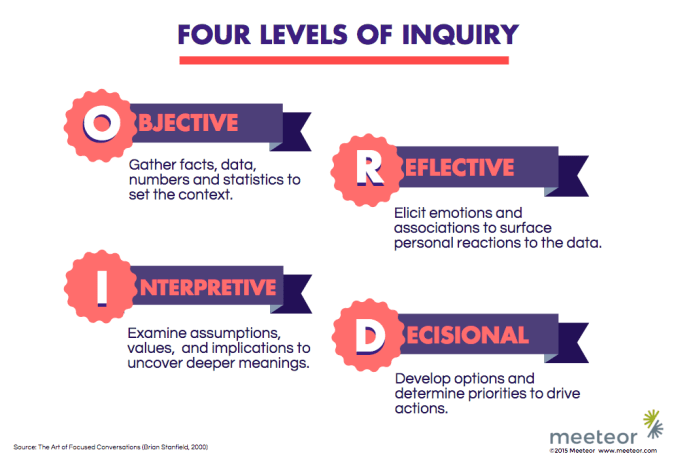
- Objective questions are easy to answer and aimed at identifying pertinent facts and information (to relieve stress and invite active participation). These are typically “what” questions, such as What were the key points you noted about…? What did you observe during the…? What body language did you notice in the participants?
- Reflective questions elicit emotional response and personal reactions, inviting a deeper level of participation. These questions ask, “What about ‘the what’?” Examples include What was the most/least successful thing you noted? What seemed to really work/not work? What concerns you/confuses you/annoys you? What was exciting, surprising, or frustrating about…? How did you feel as you were…?
- Interpretive questions invite sharing and generate options and possibilities for the future, asking “So what?” Examples include What did you learn about yourself through this experience? What are things that you might have done/could do that would have enhanced/would enhance the outcome? What do these results mean to you in terms of future planning? What other ways could you assess…? What insights have you gained about how you…?
- Decisional questions develop opinions options, or solutions that lead to future actions, clarifying expectations for improvement or change. Essentially, these are “Now what?” questions, such as What things will you do differently? What things will you do the same? Which of your skills will you further develop, and what will you do to develop them? What are your next steps? What supports will you need to continue to work on those areas?
Hopefully, this helps you as well in whatever line of work you are in because, honestly, we are all coaches! Wish me luck!
Johnson, Jessica, Leibowitz, Shira, and Perret, Kathy. (2017). The Coach Approach to School Leadership: Leading teachers to higher levels of effectiveness. ASCD: Alexandria, VA.
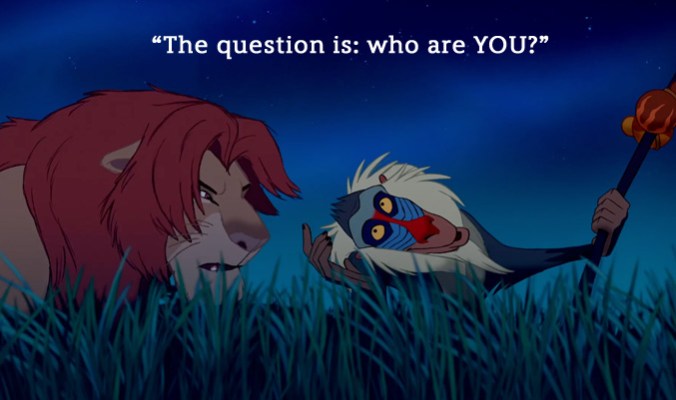 OK. Obviously, I could not resist. Disney films have a way of being so profound and yet so simple. Primple? Or simfound? I guess I won’t try to coin any new terms today. But have you ever really, thoroughly considered this question: Who are you?
 EdShots